
Nutrition
How Many Calories Should You Eat to Lose Weight? A Simple Guide for Indian Diets
Calculate how many calories you should eat to lose weight with an Indian diet. Learn maintenance calories, safe deficits, portions and meal examples.
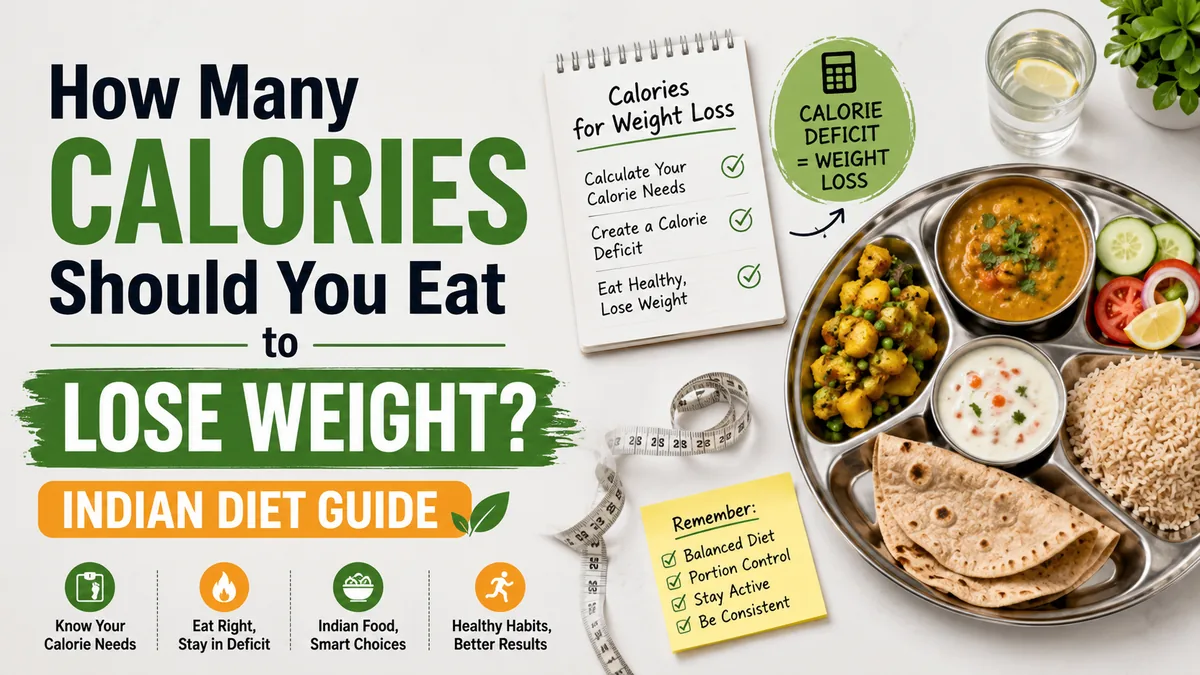
For example:
- If your maintenance intake is 2,000 calories, you could start around 1,400–1,700 calories.
- If your maintenance intake is 2,500 calories, you could start around 1,900–2,200 calories.
- If your maintenance intake is 3,000 calories, you could start around 2,400–2,700 calories.
These are starting estimates—not universal prescriptions. Your ideal calorie intake depends on your age, body size, activity level, health, medication use and weight-loss goal.
The NHS uses a reduction of about 600 calories per day as a general weight-loss starting point, while the CDC recommends gradual weight loss of approximately 0.45–0.9 kg per week because it is more likely to be sustainable. (nhs.uk)
Calorie target formula
Weight-loss calories = estimated maintenance calories − moderate calorie deficit
Your result should be treated as an initial target. Follow your average weight trend, hunger, energy, training performance and dietary consistency before deciding whether the target needs to change.
What are maintenance calories?
Your maintenance calories are the approximate number of calories your body uses in a day while keeping your weight relatively stable.
This daily energy expenditure includes:
- Energy required for breathing, circulation and other essential functions
- Energy used to digest and process food
- Walking and routine daily movement
- Planned exercise
- Work and household activity
Your maintenance intake is not necessarily the same as someone else’s—even when you both have the same body weight.
Height, age, body composition, physical activity, occupation and several health-related factors can change energy requirements. The CDC notes that medicines, medical conditions, stress, genes, hormones, environment and age may all influence weight management. (CDC)
How to calculate your weight-loss calories
Step 1: Estimate your maintenance calories
The most practical method is to use a personalised calorie calculator that considers your:
- Age
- Height
- Current weight
- Sex used by the calculator
- Daily activity
- Planned physical activity
- Target weight
- Intended timeframe
The US National Institute of Diabetes and Digestive and Kidney Diseases provides a Body Weight Planner that uses validated mathematical models of human metabolism to estimate how calorie and activity changes may affect body weight over time. (NIDDK)
This type of dynamic model is more useful than assuming that the same calorie deficit will produce identical weight loss every week. As body weight changes, the number of calories required to maintain that body weight may also change.
Step 2: Select a moderate deficit
Once you have estimated your maintenance calories, subtract approximately 300–600 calories.
| Estimated maintenance | Conservative deficit | Moderate deficit | Example starting range |
|---|---|---|---|
| 1,800 kcal | 300 kcal | 500 kcal | 1,300–1,500 kcal |
| 2,000 kcal | 300 kcal | 500 kcal | 1,500–1,700 kcal |
| 2,200 kcal | 300 kcal | 500 kcal | 1,700–1,900 kcal |
| 2,500 kcal | 300 kcal | 600 kcal | 1,900–2,200 kcal |
| 2,800 kcal | 300 kcal | 600 kcal | 2,200–2,500 kcal |
| 3,000 kcal | 300 kcal | 600 kcal | 2,400–2,700 kcal |
These ranges are mathematical examples, not individual medical recommendations.
A smaller deficit may be more suitable when you:
- Are already close to your goal weight
- Feel excessively hungry on a larger deficit
- Perform frequent strength or endurance training
- Want to preserve exercise performance
- Have difficulty following restrictive diets
A larger deficit is not automatically better. An aggressive target that you cannot consistently follow may produce worse long-term results than a moderate target you can maintain.
Step 3: Track the trend, not one weigh-in
Follow your target consistently and compare average body weight over time.
Body weight can temporarily move up or down because of:
- Water retention
- Salt and carbohydrate intake
- Menstrual-cycle changes
- Digestion and bowel contents
- A recent restaurant meal
- Changes in exercise
- Different weighing times
Weigh under similar conditions and focus on the direction of the longer-term trend rather than reacting to one day.
If your average weight is gradually decreasing and you feel well, your current target may be appropriate. If there is no meaningful change despite consistent tracking, review portions, oils, snacks, drinks and weekend meals before cutting calories again.
How fast should you try to lose weight?
A commonly recommended sustainable rate is approximately 0.5–1 kg per week, although some people will lose more slowly and others may initially lose more because of water-weight changes.
The CDC states that people losing weight at a gradual pace of about one to two pounds per week are more likely to keep it off than those losing weight more quickly. (CDC)
However, this does not mean everyone must lose 0.5 kg every week. A smaller person with lower maintenance calories may need a slower target to avoid an excessively restrictive diet.
Weight loss also does not occur in a perfectly straight line. Your calorie target should be evaluated over a meaningful period rather than judged from several days of scale readings.
Do you need to stop eating rice or roti?
No. Weight loss does not require eliminating rice, roti, dal, idli, dosa or other traditional Indian foods.
Your overall calorie intake, portions, meal composition and consistency matter more than banning one particular carbohydrate source.
A calorie-controlled Indian diet can include:
- Rice
- Roti, phulka or bhakri
- Dal and legumes
- Paneer or tofu
- Eggs, chicken or fish
- Curd or buttermilk
- Seasonal fruit
- Vegetables and salads
- Nuts and seeds
- Millets and other whole grains
The goal is to construct portions that fit your daily calorie target while providing sufficient nutrients, protein, fibre and food variety.
ICMR–National Institute of Nutrition’s 2024 Dietary Guidelines for Indians contain 17 guidelines focused on health promotion and disease prevention across different age groups. The guidance also recognises the importance of physical activity and other lifestyle and environmental factors alongside food intake. (nin.res.in)
A practical Indian meal structure for weight loss
Instead of searching for special “fat-burning foods,” organise your meals around several functional components.
1. Include a meaningful protein source
Possible Indian protein sources include:
- Dal, rajma, chana and other pulses
- Soy chunks, tofu and tempeh
- Paneer and curd
- Eggs
- Chicken
- Fish and seafood
- Lean meat
- Milk or unsweetened dairy alternatives
Protein does not cancel calories, but it can make meals more nutritionally complete and support muscle maintenance when combined with appropriate resistance training.
2. Add vegetables or fruit
Include vegetables in main meals and use fruit as a snack or meal component.
The World Health Organization recommends that people older than 10 aim for at least 400 grams of fruit and vegetables per day and at least 25 grams of naturally occurring dietary fibre. (World Health Organization)
3. Choose a measured carbohydrate portion
Your meal may include rice, roti, poha, upma, idli, dosa, oats, millet or another grain. The correct portion depends on your calorie needs, activity and the rest of the meal.
Carbohydrates do not need to be removed. They need to be counted accurately enough that your overall intake remains aligned with your target.
4. Account for cooking fats
Oil, ghee, butter, cream, coconut and nut-based gravies can substantially increase a meal’s calorie content without visibly increasing its size.
This is one of the reasons a homemade curry and a restaurant version of the same dish may have very different calorie values.
Measure the oil used in cooking and divide it across the number of portions prepared. Avoid assuming that vegetables, dal or paneer dishes are automatically low in calories.
Illustrative 1,700-calorie Indian day
The following is an example—not a prescription. Actual calories depend on ingredients, portion sizes, cooking oil and preparation.
Breakfast: approximately 350–400 calories
- Vegetable poha prepared with a measured quantity of oil
- Plain curd
- Tea or coffee with controlled sugar
Lunch: approximately 500–550 calories
- Two medium phulkas
- One bowl of dal
- One bowl of vegetable sabzi
- Salad
- Plain curd
Snack: approximately 200–250 calories
- One seasonal fruit
- Roasted chana or a controlled portion of nuts
Dinner: approximately 500–550 calories
Choose one:
- Rice, chicken curry and vegetables
- Rice, rajma and vegetables
- Roti, paneer or tofu bhurji and salad
- Millet khichdi with curd and vegetables
Flexible allowance: approximately 50–100 calories
This can account for milk in tea, small recipe differences or condiments.
The purpose of this example is not to prescribe identical meals every day. It demonstrates how familiar Indian foods can fit inside a calorie target when portions and cooking ingredients are considered.
Hidden calories that can slow progress
Cooking oil and ghee
A quick unmeasured pour can add more calories than expected. Measure cooking fats with a spoon or weigh the bottle before and after preparing a large recipe.
Restaurant gravies
Restaurant dishes may contain additional oil, butter, cream, sugar, cashews or larger portions than homemade versions.
Treat restaurant calorie estimates as approximations and avoid trying to calculate them with unrealistic precision.
Tea, coffee and beverages
Sugar, flavoured syrups, cream, full-fat milk and sweetened beverages contribute calories even though they may not feel like a meal.
“Healthy” snacks
Nuts, peanut butter, granola, protein bars, dates and dried fruit can provide useful nutrients, but portions can become calorie-dense quickly.
Weekend portions
Eating close to your target during the week does not guarantee a weekly calorie deficit when weekend meals are significantly larger.
Calories added after exercise
Exercise supports health and weight management, but wearable-device calorie estimates should not automatically be treated as an allowance to eat more.
The CDC explains that physical activity and reduced calorie intake can jointly create a calorie deficit. It also notes that most initial weight loss comes from decreasing calorie intake, while regular activity is particularly important for maintaining weight loss. (CDC)
Should you eat 1,200 calories per day?
A 1,200-calorie diet is not automatically suitable for every adult.
For some smaller, less-active adults, it may be close to an appropriate professionally designed target. For many other adults—particularly taller people, active people or those with higher body weights—it may be unnecessarily restrictive.
NIDDK material advises against eating fewer than 1,200 calories per day in its diabetes-prevention weight-loss guidance. (NIDDK)
Do not select 1,200 or 1,500 calories only because the number is popular online. Calculate your approximate maintenance requirements first and obtain professional guidance when your required intake may be low.
Very-low-calorie diets are not suitable or safe for everyone and are generally used only in specific circumstances under professional supervision. (nhs.uk)
Is exercise necessary for weight loss?
A calorie deficit can be created by reducing food intake, increasing activity or combining both.
Exercise is still valuable because it can support:
- Cardiovascular fitness
- Strength and mobility
- Physical function
- Weight-loss maintenance
- Mental wellbeing
- A higher overall activity level
The World Health Organization recommends that adults generally complete 150–300 minutes of moderate aerobic activity per week, or 75–150 minutes of vigorous activity, along with muscle-strengthening activities on at least two days per week. (World Health Organization)
Beginners do not need to achieve the full amount immediately. Start from a manageable level and increase progressively.
How to adjust your calorie target
Use this practical review process:
- Follow your estimated target as consistently as reasonably possible.
- Track meals, drinks, oils and snacks.
- Weigh yourself under comparable conditions.
- Compare weekly averages instead of individual days.
- Review waist measurements, energy, hunger and workout performance.
- Confirm that portions and cooking fats are being recorded correctly.
- Make small adjustments instead of repeatedly changing the plan.
When progress is occurring, avoid cutting calories only to make it happen faster.
When progress has genuinely stopped, first check tracking accuracy and consistency. If those are already strong, a modest calorie or activity adjustment may be appropriate.
When should you speak to a professional?
Get advice from a doctor or qualified dietitian before starting a calorie deficit when you:
- Are pregnant or breastfeeding
- Are younger than 18
- Are underweight
- Have a history of disordered eating
- Have diabetes or use glucose-lowering medication
- Have kidney, liver or other significant medical conditions
- Take medication that affects appetite or weight
- Are experiencing unexplained weight change
- Need a very-low-calorie diet
- Frequently experience weakness, dizziness or fainting
Calorie calculators provide estimates. They cannot diagnose medical conditions or replace personalised care.
Frequently Asked Questions
How many calories should I eat to lose weight?
Estimate your maintenance calories and subtract approximately 300–600 calories as a starting point. Your actual target depends on your body size, activity, health and ability to follow the plan consistently.
How many calories should an Indian woman eat to lose weight?
There is no single calorie target for every Indian woman. A woman’s calorie needs vary according to age, height, weight, activity, muscle mass and health. Calculate maintenance calories first instead of automatically selecting a 1,200- or 1,500-calorie diet.
How many calories should an Indian man eat to lose weight?
There is no universal calorie target for every Indian man. Estimate maintenance calories from personal measurements and activity, then apply a moderate deficit. A larger body or highly active lifestyle will generally require more energy than a smaller or less-active one.
Can I lose weight while eating rice every day?
Yes. Rice can fit into a weight-loss diet when its portion and the complete meal remain compatible with your calorie target. Account for curries, oil, ghee, fried sides and second servings rather than evaluating rice in isolation.
Can I lose weight without counting calories?
Yes. Some people create a calorie deficit through consistent portions and meal habits without recording every calorie. However, temporary tracking can help you understand portion sizes, cooking fats and calorie-dense foods.
How many calories are needed to lose 1 kg?
There is no exact calorie number that guarantees a one-kilogram loss for every person. Body-weight change is dynamic, and calorie needs change over time. Use a personalised model and follow your actual trend rather than relying on a fixed “calories per kilogram” rule. The NIDDK Body Weight Planner was designed to account for these changing metabolic requirements. ([NIDDK][3])
The bottom line
The right calorie intake for weight loss is not one fixed number.
Start by estimating your maintenance calories, reduce them by approximately 300–600 calories, and build your meals from familiar foods that fit your culture and preferences.
You do not need to stop eating rice, roti, dal or other Indian foods. You need a calorie target that is realistic, nutritionally adequate and sustainable—supported by accurate portions, sufficient activity and consistent review.
Eleviy can help you log Indian meals, review estimated calories and macros, follow weight trends and adjust your plan based on your routine and goals.
This article is for general education and does not constitute medical or individual dietary advice. Calorie and meal estimates vary by person, recipe, ingredients and serving size.