
Nutrition
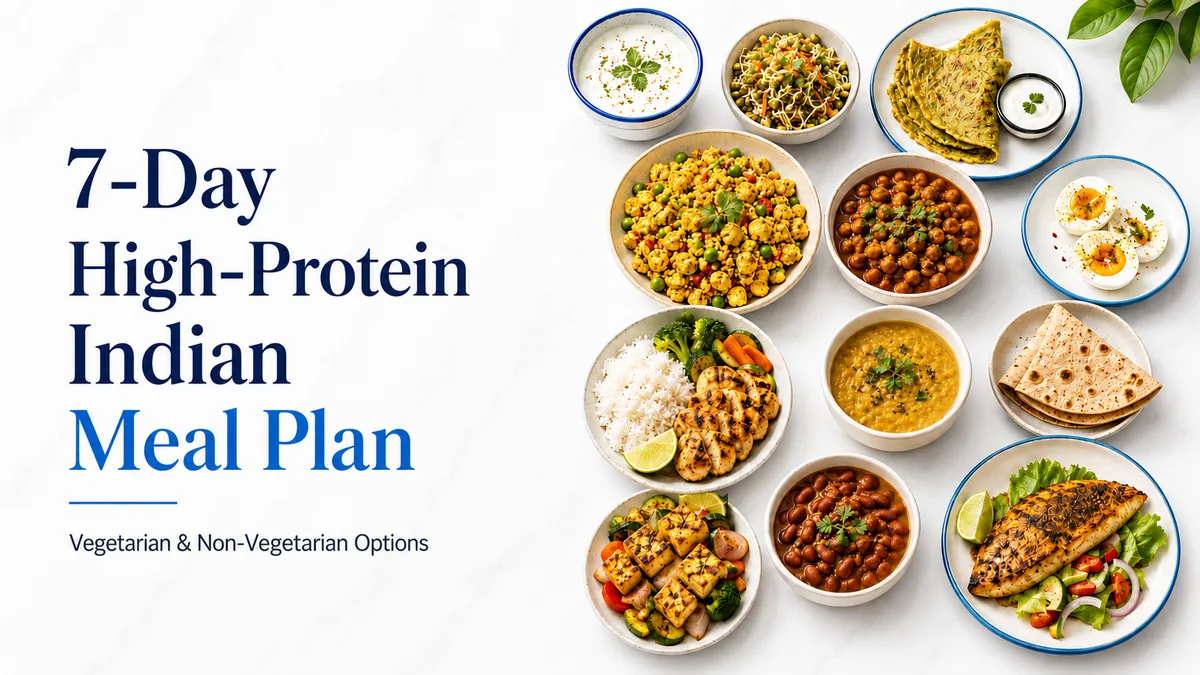
7-Day High-Protein Indian Meal Plan for Fat Loss: Vegetarian and Non-Vegetarian Options
Follow this practical 7-day high-protein Indian meal plan for fat loss, with vegetarian and non-vegetarian options for every day.
For healthy adults trying to preserve muscle while losing weight, research commonly evaluates protein intakes around 1.2–1.6 grams per kilogram of body weight per day. Your personal requirement may differ according to your body weight, activity, health and training routine. (PMC)
For a 70 kg adult, that research range equals approximately 84–112 grams of protein per day.
Protein alone does not cause fat loss. Your total calorie intake must still remain below the calories your body uses.
How to use this meal plan
For each meal, select either the vegetarian option marked V or the non-vegetarian option marked NV.
Use these general serving sizes:
- Paneer or tofu: approximately 100–150 g
- Chicken or fish: approximately 120–150 g
- Cooked dal, rajma or chana: approximately 1–1½ cups
- Curd: approximately 150–200 g
- Eggs: two or three
- Roti: one or two, depending on your calorie target
Adjust rice, roti, oil and snack portions according to your personal calorie needs. Protein and calorie estimates will vary by recipe, ingredients and cooking method. Indian food composition data can be checked using ICMR–NIN’s Indian Food Composition Tables. (ICMR-National Institute of Nutrition)
Seven-day high-protein Indian meal plan
| Day | Breakfast | Lunch | Snack | Dinner |
|---|---|---|---|---|
| 1 | V: Moong dal chilla with curd NV: Vegetable omelette with curd | V: Rajma, roti and salad NV: Chicken curry, roti and salad | Roasted chana and buttermilk | V: Tofu bhurji with vegetables NV: Grilled fish with vegetables |
| 2 | V: Paneer bhurji with one roti NV: Three boiled eggs with one roti | V: Chole, small rice portion and salad NV: Chicken rice bowl with salad | Fruit with unsweetened curd | V: Soy-chunk curry with roti NV: Egg curry with roti |
| 3 | V: Besan chilla stuffed with paneer NV: Egg bhurji with toast or roti | V: Dal, mixed vegetables, curd and roti NV: Fish curry, rice and vegetables | Sprout chaat | V: Palak tofu or paneer NV: Chicken tikka with salad |
| 4 | V: Overnight oats with milk, curd and seeds NV: Eggs with vegetable poha | V: Mixed-dal khichdi with curd NV: Chicken khichdi with curd | Roasted soy nuts or chana | V: Chana salad bowl NV: Fish or chicken salad bowl |
| 5 | V: Paneer-stuffed roti with curd NV: Egg-stuffed roti with curd | V: Tofu pulao with raita NV: Chicken pulao with raita | Milk or buttermilk with roasted chana | V: Dal, vegetable sabzi and roti NV: Egg bhurji, vegetables and roti |
ICMR–NIN recommends obtaining nutrients from varied food groups, including cereals, pulses, dairy, vegetables, fruits, nuts and—where consumed—eggs, fish or meat. Its reference “My Plate” model for a 2,000-calorie diet includes pulses, milk or curd, vegetables, fruit, nuts and controlled quantities of fats and oils. (ICMR-National Institute of Nutrition)
Three rules that make the plan work
1. Maintain a calorie deficit
High-protein food still contains calories. Measure cooking oil, ghee, nuts, paneer, gravies and restaurant portions instead of tracking only rice and roti.
2. Keep vegetables and fibre in the plan
Do not replace vegetables with extra protein. WHO recommends a varied diet built around fruits, vegetables, pulses, whole grains and lean protein sources, with at least 400 g of fruits and vegetables per day for most people older than ten. (World Health Organization)
3. Combine the diet with strength training
Resistance training gives your body a reason to retain muscle while you lose weight. Higher protein intake appears most useful for lean-mass retention when combined with appropriate exercise. (PubMed)
Frequently Asked Questions
Can vegetarians get enough protein from an Indian diet?
Yes. A planned vegetarian diet can combine dal, rajma, chana, soy, tofu, paneer, milk, curd, sprouts, nuts and seeds. Avoid depending on small portions of dal alone.
Is paneer good for fat loss?
Paneer provides protein but can also contain substantial fat and calories. Control the portion or choose lower-fat paneer when required by your calorie target.
Do I need protein powder?
Not necessarily. Many people can meet their requirements using food. Supplements should fill a genuine dietary gap rather than replace balanced meals.
Is this plan safe for kidney disease?
People with kidney disease, liver disease, diabetes, pregnancy, eating-disorder history or other medical conditions should obtain an individual meal plan from a qualified healthcare professional.
The bottom line
A successful high-protein Indian fat-loss diet does not require giving up rice, roti or traditional meals.
Keep a suitable protein source in every meal, measure calorie-dense ingredients, eat vegetables and fruit, and adjust portions to your calorie target.
Use Eleviy to scan your meals, review estimated calories and protein, track your daily intake and make changes based on your progress.
This meal plan is for general education and is not a personalised medical or nutritional prescription.